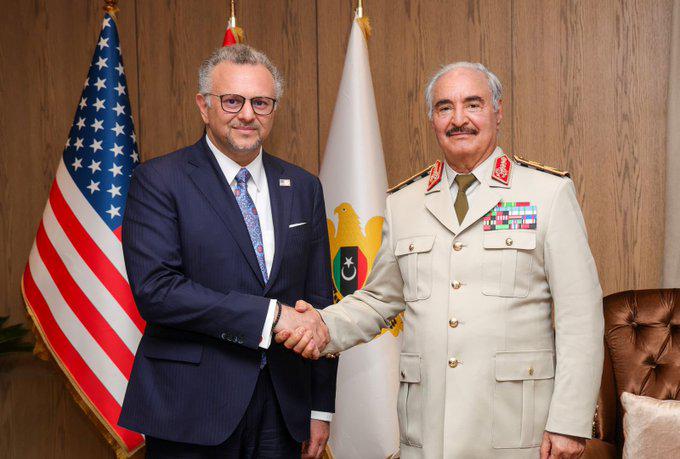

Trump’s Senior Adviser Massad Boulos meets Field Marshal Khalifa Haftar in Benghazi, on July 24, 2025.
Wednesday, July 8, 2026
The Libyan crisis has returned to the center of international diplomatic activity as the United States shows signs of becoming more directly involved in efforts to end the country’s long-running political and institutional division. This new push, linked to an initiative led by Massad Boulos, a senior adviser to the U.S. president, appears to go beyond earlier approaches that mainly focused on managing the crisis or limiting its consequences. Instead, it seeks to reshape the political and security landscape by unifying institutions, reorganizing executive power, and preparing the ground for a new political phase.
The initiative is also part of a wider regional and international context. Meetings involving the United States, Egypt, Saudi Arabia, and Turkey suggest an effort to build broader political support for a possible settlement. Washington also appears careful not to present its initiative as a complete alternative to the United Nations process. Rather, it may work alongside UN efforts, particularly on unifying Libya’s political, economic, and security institutions and creating conditions for nationwide elections.
A Growing U.S. Push to Break Libya’s Political Deadlock
The importance of the U.S. initiative lies in its timing. It comes after years of failed international and UN-led efforts to end Libya’s divided system of power. Since the collapse of the electoral process planned for December 2021, the country has remained divided between the Government of National Unity in Tripoli and the authorities based in the east. At the same time, political, military, and economic power centers on both sides have become stronger.
Against this background, the new U.S. approach appears to recognize the balance of power on the ground. Rather than trying to bypass the dominant actors, Washington seems to be exploring arrangements that would include them in a new unified structure.
Discussions have focused on a possible formula bringing together the main power centers in eastern and western Libya. Reports have suggested a redistribution of senior positions, including the possibility of Abdel Hamid Dbeibah remaining prime minister of a unified government while the Haftar camp gains a leading position in the Presidency Council.
The meeting between Saddam Haftar and senior U.S. officials in Washington, including Secretary of State Marco Rubio, together with Massad Boulos’s involvement in the process, shows that the United States is no longer simply watching developments from a distance. U.S. discussions about unifying Libya’s military, economic, and political institutions also suggest that the initiative goes beyond forming another government. It could involve a broader reorganization of state institutions and centers of power.
The recent agreement on a unified budget supports this view. Presented as a major breakthrough after years of financial division, the agreement showed that U.S. mediation can help competing power centers reach common ground when sufficient political pressure and incentives exist. The current initiative may therefore be seen as an attempt to extend this approach from the economic sphere to the political and institutional levels.
However, the initiative also raises serious concerns. Rebuilding political authority through a direct agreement between dominant political and family networks could produce formal unity without solving Libya’s deeper crisis of legitimacy. Bringing the Haftar and Dbeibah camps into the same political structure could also move the conflict inside the state rather than end it.
This leads to a central question: will the initiative create a genuine transitional process leading to elections, or will it establish a new system for sharing influence among the existing power centers?
Growing Acceptance, Especially in Eastern Libya
Although the final details of the initiative remain unclear, available information suggests that several Libyan actors are willing to engage with it. This is particularly visible in eastern Libya. The General Command has shown readiness to consider the new initiative, while statements from political figures linked to the eastern camp indicate a relatively positive view of the U.S. effort.
There are several reasons for this response. First, the initiative appears to give greater attention to security and military issues than previous efforts, which often focused mainly on elections and constitutional rules. Many actors in eastern Libya see the country’s main problem as the military division, the spread of armed groups, and the absence of a unified security structure. From this perspective, any initiative that prioritizes the unification of military institutions is more closely aligned with the eastern camp’s political and security vision.
A second factor is the possibility that a new settlement could give the Haftar camp a formal and central position within a unified state structure. If reports about Saddam Haftar taking a leading role in the Presidency Council prove accurate, this would significantly change the position of the General Command. It would move from being a force that controls eastern Libya and parts of the south to becoming an actor with formal authority at the national level.
Saddam Haftar’s reception in Washington also carries political significance beyond protocol. It reflects the U.S. administration’s willingness to deal directly with the effective leadership in eastern Libya and gives the Haftar camp greater recognition as a key player in any future arrangement. Eastern Libya may therefore see the initiative not simply as another round of negotiations, but as an opportunity to reshape its position within the Libyan state.
The situation in western Libya is more complicated. Some western actors remain cautious about any arrangement that could expand Haftar’s influence within sovereign institutions, especially given the memory of the 2019–2020 war for Tripoli. Political and armed groups in cities such as Misrata may also resist a settlement that gives the eastern military leadership a stronger position within the central government.
For this reason, claims of broad acceptance should be treated carefully. There are clear signs of regional and international support, strong interest from the east, and contacts with western actors. But this does not amount to a final Libyan consensus.
The initiative’s success will depend on its ability to expand the circle of support and provide guarantees that prevent power-sharing arrangements from becoming a tool for one side to dominate the other.
Pakistan as a Potential Mediator in Libya
Alongside the U.S. initiative, Pakistan has emerged as a possible mediator between eastern and western Libya. The importance of Pakistan’s role comes from its ability to maintain relations with the eastern leadership while also opening channels of communication with the Government of National Unity in Tripoli.
Relations between Islamabad and the eastern camp have developed significantly, particularly following Pakistani army chief Field Marshal Asim Munir’s visit to Benghazi. The visit was followed by a cooperation agreement with Saddam Haftar in the security and military fields. This relationship gives Pakistan a degree of trust with the General Command, an important advantage for any actor seeking to mediate in the Libyan conflict.
At the same time, Islamabad has expanded contacts with western Libya. Communication has taken place between Pakistan’s army chief and Prime Minister Abdel Hamid Dbeibah. Available information suggests that these efforts go beyond normal bilateral relations and may be part of a broader attempt to reduce tensions between Tripoli and Benghazi.
Pakistan’s possible role becomes more important amid reports that the United States is fully aware of Islamabad’s efforts and that Saudi Arabia also supports them. If coordination exists between these actors, Pakistani mediation could serve as a parallel channel supporting the U.S. initiative rather than competing with it.
Pakistan has several advantages that could help it play this role. It is not one of the traditional powers directly competing for influence in Libya, and it does not carry the same political legacy as some European or regional actors. The influence of Pakistan’s military establishment and its broad security relationships may also help it communicate with military actors, which is particularly important in a crisis where security division remains one of the central problems.
However, the success of Pakistani mediation will depend on its ability to maintain balance between the two sides. Its growing military relationship with the Haftar camp could create suspicion among some western Libyan actors, especially if Islamabad is seen as being closer to Benghazi than to Tripoli.
Pakistan will therefore need to show that its role is not designed to strengthen one side, but to facilitate a wider agreement that supports the broader U.S. and regional diplomatic effort.
The Future of Russia’s Presence in Libya After the U.S. Initiative
The future of Russia’s presence is one of the most sensitive aspects of the U.S. initiative. For Moscow, Libya is not simply a local arena of influence. It has become part of a wider geopolitical and logistical network extending toward the Sahel and sub-Saharan Africa. Libya’s strategic importance to Russia has also increased following changes to Moscow’s position in Syria, making its Libyan bases and facilities even more valuable.
From this perspective, the U.S. initiative could directly or indirectly challenge Russian influence. If Washington succeeds in helping unify Libya’s military and political institutions, it could become easier to reopen the issue of foreign forces and increase pressure to reduce foreign military presence.
A unified central authority could also limit the ability of outside powers to use Libya’s institutional divisions to build separate relationships with competing centers of power.
Some assessments suggest that one of the undeclared goals of the U.S. push may be to contain Russian influence in North Africa. However, this would likely happen through political pressure and a reshaping of the balance of power rather than through direct confrontation. Washington understands that attempting to force Russia out of Libya could lead to dangerous escalation. A political settlement may therefore offer a way to gradually reduce Moscow’s room for maneuver.
Still, the success of the initiative would not necessarily mean the end of Russia’s presence in Libya. Moscow has built deep ties with the eastern camp, and its presence has become part of the existing military balance. If the initiative strengthens Saddam Haftar’s position or gives the eastern camp a stronger role within a unified authority, Russia could face an important paradox: a U.S.-backed initiative intended partly to contain Russian influence might also strengthen local actors with close ties to Moscow.
Several scenarios are possible.
The first is a gradual reduction of Russia’s presence under U.S. and international pressure, especially if a unified government gains enough legitimacy to demand the withdrawal of foreign forces.
The second is a redefinition of Russia’s role, with Moscow shifting from a direct military presence toward more formal security and economic partnerships.
The third is the continuation of the current Russian position, supported by Moscow’s ties with the eastern camp, particularly if the political settlement remains fragile and military institutions are not fully unified.
In the short term, the continuation or reorganization of Russia’s presence appears more likely than a complete withdrawal. The U.S. initiative is still developing, and any unified authority would need broad internal support before addressing a sensitive issue such as the removal of foreign forces. Russia also holds political, military, and logistical assets that make a rapid exit difficult to imagine.
Recent developments suggest that the Libyan crisis is entering a new phase that goes beyond the traditional framework of stalled UN initiatives. The United States is becoming more directly involved in efforts to reshape the political landscape, using its relations with influential regional powers and its ability to communicate with key actors in both eastern and western Libya.
The eastern camp appears more willing to engage with the initiative, particularly because it could gain a stronger institutional position within a unified authority. The situation in western Libya remains more complex due to the number of political and armed actors and their concerns about the expansion of Haftar’s influence.
At the same time, Pakistan’s growing involvement raises the possibility of a new mediator capable of communicating with both sides. Islamabad may benefit from its close military ties with the east, its expanding contacts with Tripoli, and reported U.S. awareness and Saudi support for its efforts.
The main geopolitical test, however, will concern Russia. A successful U.S. initiative could reduce Moscow’s room for maneuver and increase pressure on its military presence, but it would not automatically remove Russia from Libya. The result may instead be a more complex process of Russian repositioning, supported by Moscow’s ties with actors that could gain influence under a new political arrangement.
The U.S. initiative is therefore about more than unifying Libya’s institutions. It could mark the beginning of a broader reshaping of international power balances in Libya and North Africa. Its success will depend on whether it can achieve three difficult balances at the same time: bridging the divide between east and west, linking the initiative to an acceptable international and UN framework, and managing U.S.-Russian competition without turning Libya once again into an open arena for great-power rivalry.